(limited liability) • 1st in Europe since 2026


Retreat • Monastery • Seminar and Retreat Center
The Order
Awards Received by the Order
In 1998, the Mission was awarded the world’s most prestigious Gandhi Peace Prize
by the Indian government.
In 2002, the Ramakrishna Mission was selected for an honorable mention
at the UNESCO Madanjeet Singh Prize ceremony for the promotion of tolerance and nonviolence.
Sri Ramakrishna

A Brief Biography: India, with its wealth of spiritual traditions, has produced many great spiritual figures. One of the greatest was Ramakrishna (1836–1886). His life was a testament to truth, universality, love, and purity. Sri Ramakrishna was born in a village outside of Calcutta and, even as a boy, felt a natural inclination toward a spiritual life. This inclination only grew stronger as he grew older. As a young man, he became a temple priest and felt an insatiable longing for union with God, which is why he devoted himself intensely to meditation and other spiritual practices. Sri Ramakrishna’s thoughts were constantly on God. He often entered profound spiritual states in which he merged with infinite reality. For him, the Vedantic teaching of the unity of all being —was more than just a theory; he literally saw and knew that this was true. In his thirst for the Divine, Sri Ramakrishna followed various religious paths, including different branches of Hinduism. However, he was not satisfied with this alone; he also practiced Islam and later meditated deeply on Christ, experiencing the same divine reality through these non-Hindu paths. Thus, based on his direct experience, he concluded that all religions lead to the same goal (God). Furthermore, through his many Sikh followers, he came to know their faith and its great founder, and learned about the wondrous life and teachings of the Buddha. This encounter with Sikhism and Buddhism confirmed his experience of the universality of spiritual truth. Sri Ramakrishna’s love for humanity was boundless. He often said that human beings are the highest manifestations of God. His disciples experienced this love firsthand, and the monastic order inspired by Sri Ramakrishna earned the distinction of being the first order in India to dedicate itself to the service of humanity. Service to God in humanity is one of the most important ideals of the Ramakrishna Order. Among his many other remarkable qualities were his universality and childlike purity, his intense sincerity, his extensive knowledge of spiritual and human matters (which did not come from books but from direct perception), and his extraordinary power to transform lives. Sri Ramakrishna’s teachings on the highest truths of spiritual life were conveyed in the simplest language and illustrated with parables and vivid metaphors. Many well-known writers and philosophers, such as Mahatma Gandhi, Leo Tolstoy, Aldous Huxley, Christopher Isherwood, Thomas Merton, Arnold Toynbee, Joseph Campbell, and others, were deeply impressed and influenced by him.
Holy Mother Sri Sarada Devi

A Brief Biography: The Holy Mother Sri Sarada Devi was one of a kind. She was the perfect wife, nun, mother, and teacher all in one. She was an extraordinary woman who came into the world with a great message. Although she was married to Sri Ramakrishna, they did not live as husband and wife but saw the Divine Mother in one another. Today, they have become symbols of moral and spiritual perfection—for me and for women, for married and unmarried people, for laypeople as well as for monks and nuns. This is the definitive biography of her life. (from: “Holy Mother Sri Sarada Devi” by Swami Gambhirananda) Simplicity and Forbearance: Although she was highly revered for her spiritual status and literally worshiped as the Divine Mother, she continued to live like a simple village mother. She washed clothes, swept the floor, fetched water from the pond, prepared vegetables, cooked, and served meals. In Jayrambati (her birthplace), she lived with her brothers and their families. They caused her endless worries, yet because she was anchored in the consciousness of God and in Divine Motherhood, she always remained calm and self-possessed, showering everyone who came into contact with her with love and blessings. As Sister Nivedita said, “Her life was one long silence of prayer.” The Ideal Woman: Because of her spotless purity, extraordinary patience, selfless service, unconditional love, wisdom, and spiritual enlightenment, Swami Vivekananda regarded Sri Sarada Devi as the ideal for modern women. He believed that with the arrival of the Holy Mother, the spiritual awakening of women in the modern era had begun. Mother of All Beings: In the history of humanity, there has been no other woman who regarded herself as the mother of all beings—including animals and birds—and spent her entire life serving them as her children, making infinite sacrifices and demonstrating boundless selflessness. Speaking of her role in Sri Ramakrishna’s mission on earth, she said: “My son, you know that the Master had a maternal attitude (Matri-Bhava) toward everyone. He left me behind to manifest this divine motherhood in the world.” Final Days: Under the strain of constant physical labor, neglect of her own health, and repeated bouts of malaria, her health deteriorated in the final years of her life, and she departed this mortal world on July 21, 1920. (from: https://rkmath.org/sri-sarada-devi/) Words of the Holy Mother: - God belongs to us alone. It is an eternal relationship. - Ordinary human love leads to suffering. Love for God brings bliss. - Whoever makes prayer a habit will easily overcome all difficulties. - Just as the wind dispels the clouds, so the Name of God tears away the clouds of worldliness. - My child, you were very fortunate to be born as a human being. Be deeply devoted to God. You must work hard. Can anything be achieved without effort? You must set aside time for prayer even during the busiest hours of the day. - Do the Master’s work and, at the same time, practice spiritual discipline. Work helps keep idle thoughts at bay. When one has no work, such thoughts crowd the mind. - One must work. Only through work are the bonds of labor broken, and one attains a spirit of detachment. - One should always be discerning and strive earnestly for the knowledge of God. - Even water, which by nature flows downward ( ), is lifted up toward the sky by the sun’s rays. In the same way, God’s grace lifts up the mind that tends to chase after sense objects. - Through spiritual discipline, the bonds of past karma are severed. Yet the realization of God cannot be attained without ecstatic love for Him. - It is futile to expect that dangers and difficulties will not come. They are bound to come. But for a believer, they pass away like water beneath his feet. - Can a person without compassion be called a human being? He is a true beast. - I’ll tell you one thing: If you want peace, then don’t look for faults in others. Rather, look at your own faults. Learn to make the whole world your own. No one is a stranger, my child; the whole world belongs to you. - When a person sees faults in others, his own mind is defiled first. What good does it do him to find faults in others? He only harms himself in doing so. - All teachers are one. The same power of God works through them all. - I am your true mother—a mother not because I am your guru’s wife, nor because I speak empty words, but truly your mother. - I am the mother of both the virtuous and the wicked. - When my son rolls in the dust or mud, it is I who wipe away all the dirt and take him into my lap. - My son, when a thorn pricks your foot, it hurts me as if a spear were piercing my heart. Do not be afraid, and when you are in distress, simply tell yourself, “I have a mother.” (from: https://rkmath.org/sri-sarada-devi/)
The Origins of the Ramakrishna Order
Swami Vivekananda

Before Sri Ramakrishna passed away in 1886, he called upon his closest and most devoted disciples to pass on his teachings and spiritual guidance to humanity, so that everyone might apply and practice them for themselves. Prior to this , he himself, together with his devoted follower named “M.,” compiled all his teachings and instructions into the sacred text *The Gospel of Sri Ramakrishna*, which is now widely circulated and highly esteemed throughout the world. Before ending his earthly life, Sri Ramakrishna presented his closest and most devoted disciples with ochre-colored robes and entrusted his foremost disciple, Swami Vivekananda, with the great task of founding an order of monks for the benefit of humanity. In 1897, the Ramakrishna Order was founded by Swami Vivekananda. Very soon afterward, Swami Vivekananda traveled to the West—to America— to spread the teachings of his master, Sri Ramakrishna, and to bring East and West closer together. On September 11, 1893, he delivered his world-famous opening address at the World’s Parliament of Religions in Chicago on the unity of all people and religions. He began his speech with the words “Sisters and brothers of America,” prompting the approximately 7,500 people in attendance to throw their hats in the air and rush toward him over the balustrades. In this speech, he emphasized the unity of all religions, universal tolerance, and the ideals of Indian culture. He also emphasized the original and fundamental role of Hinduism as a religion open to all and one that protects the persecuted of all faiths. At first, his monastic brothers who remained in India had nothing but an old, dilapidated, crumbling house—one that leaked when it rained—in which to live. Here they lived under the most difficult conditions and often went hungry, yet remained strong and steadfast in their loyalty to their master, thereby laying the foundation for the monastic order of Sri Ramakrishna, and later also for the nuns’ order of Holy Mother, Sri Sarada Devi.

On September 11, 1893, Swami Vivekananda delivered his world-famous opening address
on the unity and harmony of all people and religions.
The Emblem of the Ramakrishna Order
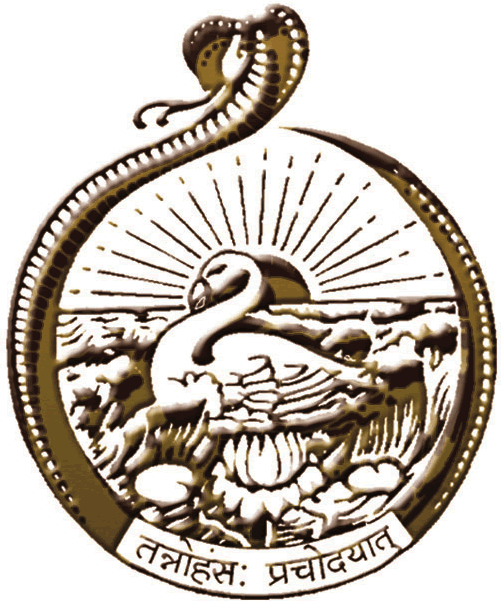
The emblem of the Ramakrishna Order, designed by Swami Vivekananda, is a unique and incomparable work of art, created by one of the most significant minds in modern history in a sublime state of spiritual inspiration. It is a profound symbol of harmony and synthesis, inviting reverent meditation in our age of conflict and disharmony. This symbol embodies Swamiji’s message of harmony and synthesis, which leads to a fulfilled life. It is the most eloquent expression of what he truly preached and what he wished to bestow upon every man and woman— whether in the East or the West. The goal is to recognize, even in this lifetime, the true Self —the self-radiant Atman, the “swan” in the emblem— and, through this realization, to be free from all limitations, all bonds, and all pettiness. This spiritual freedom is a goal to be strived for and attained. It liberates one from the prison of limited individuality and bestows the blessing of universal existence. Then one becomes one with the Absolute of existence, knowledge, and bliss. “Be free. That is the whole of religion,” said Swamiji. The meaning of this emblem in Vivekananda’s own words: - The “rippling water” symbolizes karma (the result of actions), - the “lotus” symbolizes bhakti (love), and - the “rising sun” symbolizes jnana (knowledge). - The “coiling serpent” symbolizes yoga and the awakened Kundalini Shakti, - while the “swan” represents Paramatman (the World Soul). The idea behind the image is therefore that... “through the union of karma, jnana, bhakti, and yoga, the vision of the Paramatman is attained.” तन्नो हंस: प्रचोदयात् (Tanno hamsah prachodayat), means: “May the Paramatman, the Supreme Self, [symbolized by] the swan (hamsa), awaken our [higher] understanding.” (from: https://belurmath.org/emblem/)
About the Ramakrishna Order
The Order and Its Branches: As of October 1, 2025, Ramakrishna Math & Ramakrishna Mission had 295 branches worldwide. Of these, 226 are located in India and the remaining 69 in 24 other countries (27 in Bangladesh, 15 in the U.S., 3 in Brazil, 2 each in Canada, Russia, and South Africa, and 1 each in Argentina, Australia, Fiji, France, Germany, Ireland, Japan, Malaysia, Mauritius, Nepal, the Netherlands, New Zealand, the Philippines, Singapore, Sri Lanka, Switzerland, the United Kingdom, and Zambia). In addition, there are 58 sub-centers (27 in India and 31 outside India) that are subordinate to the branches mentioned above. (from: https://belurmath.org/branch-centres/) The Ramakrishna Mission: The Mission’s activities have been continuously expanded to this day. It operates its own hospitals, charitable pharmacies, maternity clinics, tuberculosis clinics, and mobile pharmacies. It also runs training centers for nurses. Orphanages and nursing homes are also part of the Mission’s scope of work, as is social work in rural areas and among tribal communities. In the field of education, the Ramakrishna Mission has always been ahead of its time. It has established some of India’s most outstanding educational institutions and operates its own colleges, vocational training centers, high schools, and elementary schools, as well as teacher-training institutes and schools for the visually impaired. It also operates adult education centers throughout the country. Whenever a disaster has struck, he Ramakrishna Mission has been on the scene to provide relief during famines, epidemics, fires, floods, earthquakes, cyclones, and civil unrest.
The Ramakrishna Order, based in Calcutta, is today one of the largest and most respected religious orders in India.
Belur Math,
The headquarters of
Ramakrishna Math & Ramakrishna Mission

About Us: Ramakrishna Math & Ramakrishna Mission are global, nonpolitical, and non-denominational spiritual organizations that have been engaged in various forms of humanitarian and social service for over a century. Inspired by the ideals of renunciation and service, the monks and lay followers of the Math & Mission serve millions of men, women, and children, regardless of caste, religion, or race, because they see the living God in them. ’s organizations were founded by Sri Ramakrishna (1836–1886), the great 19th-century saint from Bengal who is regarded as a prophet of the modern age, and by Sri Ramakrishna’s foremost disciple, Swami Vivekananda (1863–1902), one of the most significant thinkers and religious leaders of our time, who, in the words of the eminent Western scholar A. L. Basham, is regarded as “one of the principal shapers of the modern world.” Although Ramakrishna Math and Ramakrishna Mission are legally and financially separate, they are closely linked in many respects and are regarded as twin organizations. These two organizations have set in motion a non-denominational, universal spiritual movement that has been quietly working for over a hundred years to advance the spiritual renewal of humanity. The main catalyst for this ongoing transformation is India’s ancient religious philosophy, known as Vedanta. Although several other philosophical systems emerged in India over time, they remained confined to small groups. Vedanta alone has remained as the dominant philosophy of the Indian religious tradition from the Vedic period to the present day. In modern times, this ancient system of thought was purified, unified, and revitalized by Sri Ramakrishna, and presented in modern language by Swami Vivekananda, thus making it accessible to all people worldwide, regardless of caste, faith, or race. The Ramakrishna Order does not believe in proselytizing, nor does it indulge in the occult or sensationalism. The Order places the utmost importance on personal spiritual development and selfless service. Inspired by the idea of harmony among all faiths, its centers encourage followers of different faiths to meet in a spirit of friendship and mutual respect and to learn from one another without having to renounce their own faith. In the words of Sri Ramakrishna: “God has created different religions to suit different aspirants, lives, and countries … All teachings are merely paths; but a path is by no means God Himself. In fact, one can reach God by following any of these paths with sincere devotion.” MOTTO: The motto of the sister organizations is: “ātmāno mokṣārthaṃ jagat hitāya ca,” “For one’s own liberation and for the welfare of the world.” It was formulated by Swami Vivekananda. IDEALS: - Work as worship, - the potential divinity of the soul, and - the harmony of religions are the three notable ideals upon which these two organizations are based. This ideal... “Service to humanity as service to God” is what underpins the large number of hospitals, clinics, mobile medical units, schools, colleges, rural development centers, and many other social institutions run by the two organizations. “This Math that we are establishing will harmonize all faiths and viewpoints. Just as Sri Ramakrishna held very liberal views, this Math, too, will be a center for the dissemination of similar ideas. The radiant light of universal harmony emanating from here will flood the entire world.” Excerpt from: The Complete Works of Swami Vivekananda (Volume 7, p. 115) HEADQUARTERS: The headquarters of Ramakrishna Math & Ramakrishna Mission is loc , in Belur, Howrah District, West Bengal, India. The entire headquarters campus is commonly known as “Belur Math.” It spans 16 hectares of land on the west bank of the Hugli River (Ganga), an hour’s drive from Kolkata. Activities: *Educational Programs* Ramakrishna Math and the Ramakrishna Mission operate approximately 1,200 educational institutions (including an accredited university, colleges of arts and sciences, a Sanskrit college, a teacher-training institute, a sports college, upper secondary schools, high schools, technical colleges, computer training centers, technical and industrial schools, an academy for the blind, and vocational training centers), as well as extracurricular education centers and tutoring centers. *Medical Care* Ramakrishna Math and the Ramakrishna Mission operate 17 hospitals, 147 outpatient clinics, 64 mobile medical units, and seven nursing training institutes. Medical and ophthalmological camps are regularly organized for needy patients from rural areas. In addition, cases of leprosy are diagnosed and treated at our outpatient clinics in Belur Math, Chennai, Kamarpukur, and Lucknow. Obstetric and pediatric care are provided at our hospitals in Kolkata, Lucknow, Thiruvananthapuram, and Vrindaban, as well as at some of our outpatient clinics. *Relief and Rehabilitation Activities* The Ramakrishna Math and the Ramakrishna Mission carry out relief and rehabilitation activities in the wake of natural and man-made disasters, including cyclone/storm relief, emergency relief, flood relief, fire relief, earthquake/landslide relief, winter relief, and medical relief. Rehabilitation efforts include the construction of houses, settlements, bridges, and roads. *Services in Rural and Tribal Areas* The Ramakrishna Math and the Ramakrishna Mission provide various services for rural development, including digging wells and ponds, installing tube wells and water filters, agricultural camps and demonstrations, farmers’ fairs (Kisan Mela), distribution of seeds, seedlings, and fertilizers, soil testing, development of fallow land, construction of dams, development of animal resources, health and hygiene education programs, construction and repair of schools and community halls, provision of renewable (solar) energy units, and vocational courses in dairy farming, poultry farming, horticulture, handicrafts, tailoring, welding, computers, etc.
Address of the headquarters in India:
PO Belur Math, Dist Howrah, West Bengal
PIN 711202 (India)
Swami Vivekananda's main concern:
It should be applied in the same way to female devotees
of Sri Ramakrishna and Sri Sarada Devi.
A monastery for nuns will be created.

It was created in 1953...
SRI SARADA MATH,
& RAMAKRISHNA SARADA MISSION


Sarada Math Calcutta, About us:
Fifty years after Swami Vivekananda had renounced worldly life, numerous educated women, inspired by his ideals of renunciation and service, dedicated their lives to their own spiritual growth and to the upliftment of their sisters. In 1954, the year of the Holy Mother’s centennial, the leaders of Belur Math felt it was high time to give concrete form to Swami Vivekananda’s ideas. Consequently, a suitable plot of land with several buildings was acquired on the east bank of the Ganges, slightly north of the Dakshineswar Kali Temple. On December 2, 1954, Swami Sankarananda, the seventh president of the Ramakrishna Math and the Mission, ceremonially opened the Women’s Math in the presence of numerous high-ranking monks and trustees of the Ramakrishna Order, including... - Swami Vishuddhananda, then Vice President, - Swami Madhavananda, the General Secretary, - Swami Vireswarananda, one of the Deputy Secretaries, as well as the Brahmacharinis and numerous devotees from near and far. The opening of the Sri Sarada Math, as planned by Swami Vivekananda, added a new and very significant chapter to India’s socio-religious history. The Math was successfully managed for several years by the Brahmacharinis under the guidance of the trustees of the Belur Math. It was then decided to hand it over to the Brahmacharinis so that they could continue their work independently. Shrine: On January 1, 1959, the Holy Mother’s birthday, eight senior members of the Sarada Math were conferred sannyasa by Swami Sankarananda, then President of the Ramakrishna Math and the Ramakrishna Mission, in the old shrine of the Belur Math. This was a first step toward the establishment of an independent women’s organization. On August 26, 1959, Sri Sarada Math was granted independent status, and the Sannyasinis became its trustees by virtue of a trust deed signed by the president of the Ramakrishna Math. On May 13, 1960, the trustees of Sri Sarada Math, on the advice of the authorities of Belur Math, founded the “Ramakrishna Sarada Mission Association,” which was registered under Act XXI of 1860. Its aim was to carry out educational, cultural, charitable, and similar activities among women and children, and to regard them as true manifestations of the Divine— regardless of caste, creed, or nationality. Although Sri Sarada Math and the Ramakrishna Sarada Mission are legally separate, they essentially form a single entity, with the Ramakrishna Math and the Ramakrishna Mission serving as their counterparts. (from: https://srisaradamath.org/aboutmath.php)
Sarada Math Calcutta at YouTube:
Address in India:
Sri Sarada Math
& Ramakrishna Sarada Mission,,
Dakshineswar
Kolkata - 700 076.
West Bengal (India)
The founding of the Order’s first “Vedanta Society” in the United States of America
The first Vedanta Society, the
Vedanta Society of New York
was founded in November 1894 by Swami Vivekananda during his first trip to the West.
In 1897, Vivekananda sent Swami Abhedananda to lead the organization.
Swami Vivekananda then visited California in 1899
on his second trip to the West,
to give lectures in cities such as Los Angeles, Oakland,
San Francisco, and Alameda.
His visit played a key role in the founding of the
Vedanta Society of Northern California
- the organization he founded in 1900.
Swami Prabhavananda was one of the first swamis
sent to America by Ramakrishna’s direct disciples
to continue the work that Swami Vivekananda
at the turn of the century.
In 1923, Swami Prabhavananda arrived in the United States.
After two years as assistant minister of the Vedanta Society of San Francisco,
he founded the Vedanta Society of Portland.
In December 1929, he arrived in Los Angeles
and founded the
Vedanta Society of Southern California
Under the Swami’s expert guidance, the society grew
into one of the largest Vedanta societies in the West,
with monasteries in Hollywood and Trabuco Canyon
as well as convents for nuns in Hollywood and Santa Barbara.
Vedanta Society of Southern California, About us:
About Us: SWAMI VIVEKANANDA, the great patriot, the saint of India, had an infallible vision for the rejuvenation of his motherland. With firm conviction, he said: “The national ideals of India are renunciation and service. Cultivate these, and the rest will follow of its own accord.” Main Temple at Sri Sarada Math, Dakshineswar: With this goal in mind, he founded the Ramakrishna Math and Ramakrishna Mission to train a band of sannyasins... *to attain self-realization, *to serve the world in every possible way, and *to preach Vedanta. While establishing the aforementioned organizations, Swami Vivekananda had the idea of founding similar organizations for women, because... he knew that there could be no hope for the well-being of the world unless the condition of women was improved, just as it is impossible for a bird to fly on one wing alone. In one of his letters, he wrote: “Therefore, my first endeavor is to establish a math for women.” He also wrote: “With the Holy Mother as the center of inspiration, a math (for women) is to be established on the eastern bank of the Ganges. Just as Brahmacharins and Sadhus are trained in this math (Belur Math), so too are (female) Brahmacharinis and Sadhvis to be trained in the other math.” Although the Swami was very eager to establish a women’s Math as soon as possible, where a group of educated sannyasinis would be trained to serve humanity , his idea could not yet take shape at that time due to the lack of education among women and the prevailing social conditions. Fifty years after his death... a number of educated women, inspired by his ideals of renunciation and service, came to dedicate their lives to their own spiritual growth and to the upliftment of their sisters. In 1954, the year of the Holy Mother’s birthday, the authorities at Belur-Math felt it was high time to give concrete form to Swami Vivekananda’s ideas. Accordingly, a suitable piece of land with several buildings was acquired on the eastern bank of the Ganges, slightly north of the Dakshineswar Kali Temple. Sri Sarada Math, on the eastern bank of the Ganges River: On December 2 of that same year, Swami Sankarananda, the seventh president of Ramakrishna Math & Ramakrishna Mission, presided over the opening ceremony of the women’s math in the presence of a large number of senior monks and trustees of the Ramakrishna Order, including... - Swami Vishuddhananda, then Vice President; - Swami Madhavananda, the Secretary-General Swami The opening of Sri Sarada Math, as envisioned by Swami Vivekananda, added a new and very significant chapter to India’s socio-religious history. For several years, the Math was successfully managed by the Brahmacharinis under the guidance of the trustees of the Belur Math. It was then decided to hand it over to the Brahmacharinis so that their work could continue independently. Shrine: On January 1, 1959, on the Holy Mother’s birthday, eight senior members of Sarada Math were invested in sannyasa by Swami Sankarananda, who was then President of Ramakrishna Math and Ramakrishna Mission, in the ancient shrine of Belur Math. This was a preliminary step toward the formation of an independent women’s organization. On August 26, 1959, Sri Sarada Math was granted independent status, and the Sannyasinis became its trustees pursuant to a deed of trust executed by the president of the Ramakrishna Math. On May 13, 1960, the trustees of Sri Sarada Math, acting on the advice of the authorities of Belur Math, founded the Ramakrishna Sarada Mission Association, which was registered under Act XXI of 1860 with the aim of to continue educational, cultural, charitable, and similar activities among women and children, regarding them as true manifestations of the Divine, regardless of caste, creed, or nationality. Thus, although legally separate, Sri Sarada Math and the Ramakrishna Sarada Mission are essentially one with the Ramakrishna Math and the Ramakrishna Mission, which are their counterparts.
Address in Amerika:
Vedanta Society of Southern California
1946 Vedanta Place
Hollywood, CA 90068-3996